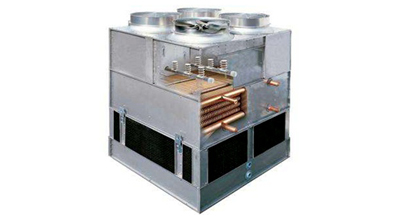
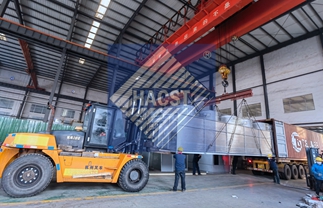
Cooling Towers in Singapore
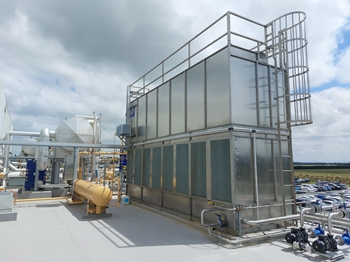
HACST is a cooling tower manufacturer and expert ready to serve projects in Singapore.
40 years of experience in cooling tower manufacturing, installation and maintenance. We have a full range of more than 10 cooling tower models that are fully customizable to meet your needs. We have completed many projects in Singapore, including hotels, shopping malls, cold storage, chemicals, pharmaceuticals, etc. You can contact our local agents and we will provide you with the most suitable cooling solution.
Reasons why the temperature of industrial circulating water cannot be lowered
The reasons why the water temperature of a closed cooling tower cannot be lowered may involve multiple aspects. The following is a detailed analysis of these reasons:
1. Insufficient air volume
Fan problem: The fan is a key component that accelerates the air flow in the tower and increases the heat exchange between air and water. If the fan size is not appropriate or the installation position is improper (such as the cooling tower is placed indoors or there are obstructions at the air inlet), the air volume will be insufficient, thereby affecting the heat exchange efficiency and preventing the water temperature from being lowered.
Fan failure: Fan blade deformation, breakage, bearing damage or transmission device failure (such as belt loosening, breakage), etc., may all lead to reduced air volume, thereby affecting the heat exchange effect.
2. Uneven spraying
Spray head blockage: Spray head blockage will cause uneven spraying, resulting in insufficient water in some areas and reducing the cooling effect. The spray head should be checked, cleaned or replaced regularly.
Water distribution trough problem: If the water distribution trough is not designed properly or fails, it may also cause uneven spraying.
3. Improper selection
The manufacturer did not fully consider the specific working conditions of the customer when selecting the model. For example, the model of the cooling tower will be different if the electric furnace is placed in a different position.
Therefore, when c...
Cooling Tower Installation in Singapore
Common parameters for cooling tower calculation
Cooling amplitude definition
The cooling amplitude refers to the difference between the cooling tower outlet water temperature and the inlet air wet bulb temperature. A smaller cooling amplitude usually means a higher performance cooling tower.
Efficiency considerations
When evaluating cooling towers, its efficiency is also an important indicator. An efficient cooling tower can more effectively reduce the water temperature, thereby ensuring stable operation of the system.
Cooling tower capacity
The capacity of a cooling tower is usually measured in “kilocalories per hour” or “tons of cooling”. The calculation formula is: Cooling tower capacity = cooling water mass flow × water specific heat capacity × temperature difference. Generally speaking, a cooling tower with a larger capacity has a higher performance.
Make-up water calculation
The make-up water volume is an important factor to consider in the operation of a cooling tower. It includes evaporation loss, splash loss, and periodic discharge loss. The amount of water lost by evaporation can be calculated by the formula E = Q/600 = (T1-T2)×L/600, where E represents the amount of water evaporated (kg/h), Q represents the heat load (Kcal/h), 600 represents the latent heat of evaporation of water (Kcal/h), T1 and T2 represent the inlet and outlet water temperatures (℃), and L represents the circulating water volume (kg/h). The amount of water lost by splashing is usually about 0.1~0.2% of the circulat...
Double circulation principle of closed cooling tower
The cooling principle of closed cooling tower involves two cycles: internal circulation and external circulation. Its core component is the copper tube surface cooler, which does not require filler.
① Internal circulation: This cycle is connected to the target equipment to form a closed circulation system in which the circulating medium is soft water. Its main task is to cool the target equipment and discharge the heat in the equipment through the cooling unit.
② External circulation: This cycle is designed for the cooling tower itself and does not come into direct contact with the internal circulation water. It only exchanges heat and dissipates heat through the copper tube surface cooler to reduce the temperature of the cooling tower. In this cycle, the motor operation is automatically controlled by the water temperature.
In spring and summer, when the ambient temperature is high, the two cycles usually need to run at the same time. In autumn and winter, due to the low ambient temperature, in most cases, only the internal circulation needs to be started to meet the needs.
Cooling tower type: closed cooling tower
Closed cooling tower, as a highly efficient cooling equipment, is widely used in many industrial fields. Its unique design and operating principle enable it to perform excellent cooling effects in different seasons and environments. At the turn of spring and summer, when the ambient temperature gradually rises,...
Installation method of cooling tower
When installing a cooling tower, it is necessary to select a suitable installation location according to the various conditions of the equipment and ensure that the ground has sufficient load capacity. At the same time, external conditions such as ventilation should also be considered. During the installation process, a horizontal steel plate should be pre-buried as the foundation according to the specified size, and the elevation of each foundation point should be ensured to be on the same horizontal plane. The tower body should be placed horizontally to prevent the chassis from being crushed. When installing the tower shell, chassis and other components, in order to prevent deformation, screws can be inserted first and then tightened step by step. In addition, care should be taken to avoid poor ventilation and humid air backflow to ensure that the cooling capacity of the cooling tower is not affected.
Usually, the cooling tower is installed on the roof of the refrigeration station to form a high pressure head to overcome the resistance loss of the condenser. The water pump draws cooling water from the pool and sends it to the cooling tower for cooling treatment. The cooled water is then pressed into the condenser by gravity for circulation. During installation, it is necessary to position it according to the coordinate position specified in the construction drawing, and level and align it to ensure that the equipment is stable and firm. At the same time, attention should...
Selection of cooling towers
When selecting a cooling tower for a particular device or system, a series of steps need to be followed. First, the total amount of heat rejection of the fluid must be determined, usually measured in Kw/h. Second, the desired inlet and outlet water temperature difference must be determined, which is particularly important in air conditioning projects because different cooling methods have different temperature difference requirements. For example, absorption chillers are generally set at a temperature difference of 8°C, while compression refrigerants are usually set at 5°C.
Next, a specific formula is used to calculate the required cooling water volume in m3/h. This formula involves multiple parameters such as the total amount of heat rejection of the fluid, the temperature difference, and the specific heat of water. It should be noted that different cooling methods use different coefficients in the calculation, such as 3.0 for absorption chillers and 1.56 for compression refrigerants.
In addition, local meteorological conditions, especially wet bulb temperature, need to be considered. When the wet bulb temperature is less than 27°C, there is generally no need to increase the design margin. However, if the atmospheric wet bulb temperature at the installation site is higher than this value, the design needs to be adjusted accordingly.
Let’s take a specific example: when selecting a cooling tower for a lithium bromide refrigerator with a coo...
Cooling Towers in Indonesia, Asia
We have been specializing in the production of cooling towers for more than 40 years, although when you go online you will find several companies that specialize in the production of cooling towers. , you can also find various portals that display a list of the top 10 cooling tower manufacturers, but it is easy to get confused when buying a cooling tower.
We are one of the top cooling tower manufacturers in Indonesia in terms of design, manufacturing, installation and maintenance of closed cooling towers. We have agents in Indonesia and we have undertaken many projects locally, including in the petrochemical industry. Food industry, pharmaceutical industry, etc.
Our advantage:
* Innovative design using the latest cooling tower technology.
* Industry leader, we have built over 20,000 cooling towers.
*Conservative thermal ratings.
* Long life structure.
* Compact yet powerful weatherproofing.
* Proven and reliable.
* Simplified maintenance.
Noise reduction treatment of cooling towers
The noise sources of cooling towers mainly come from four aspects: fan intake and exhaust noise, water spray noise, fan reducer and motor noise, and cooling tower water pump, piping and valve noise. Among them, falling water noise is a unique noise source of cooling towers. It is a steady-state water noise generated by the large-scale continuous liquid impact of cooling falling water on the pool water in the tower.
The sound source sound level of this noise is about 80dB (A), and the spectrum is mainly composed of high-frequency (1000-16000 Hz) and medium-frequency (500-1000Hz) components, with a peak at around 4000Hz. Due to the long wavelength of sound, strong penetration ability, and insignificant sound attenuation, it is difficult to control.
On the other hand, the turbulence and friction-induced pressure disturbances generated by the air in the top guide pipe of the cooling tower, as well as the vibrations generated by the blades and the air, will radiate noise outward. These aerodynamic noises are one of the main sound sources of cooling towers.
In addition, falling water noise is also a noise source that cannot be ignored. When the circulating water of the cooling tower falls freely through the packing layer to the water trough, impact noise will be generated, and its intensity is proportional to the square of the water speed. The measurement results show that the A-level noise of the falling water reaches 70dB, which is a...
FBH-400 cross flow cooling tower installed in Russia
ZHX Cooling Towers in Vietnam’s Pharmaceutical Industry
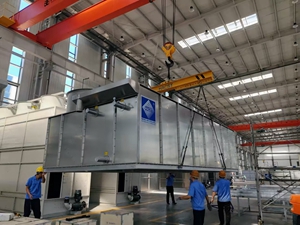
ZHX Cooling Towers in Vietnam’s Pharmaceutical Industry.Efficient ZHX cooling towers are widely used in the pharmaceutical industries.
Cooling Tower Replacement Project in Saudi Arabia
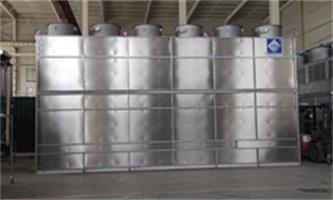
A brand-new unit is on its way to our valued manufacturing customer in Saudi Arabia. This customer wanted to replace an old competitor’s unit.
BHX Cooling Tower will be sent to Tanzania Injection Molding Factory.
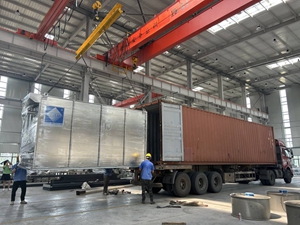
BHX Cooling Tower will be sent to Tanzania Injection Molding Factory.Timely delivery and high-quality service have always been our goal.
ZNX Evaporative Condenser will be sent to Türkiye.
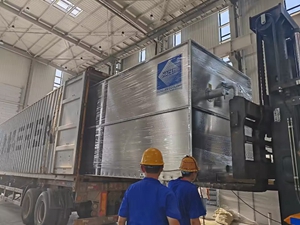
5 sets of ZNX Counterflow Evaporative Condenser will be sent to Türkiye.Our products have been widely used in the petrochemical industry.
ZHX Cooling Tower made its way up to Ecuador
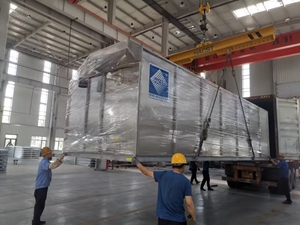
This Series ZHX-1840 Cooling Tower made its way up to Ecuador this month. Our customers come from the petrochemical industry and they have great trust in our products and services.
Installation of FRP Cooling Tower in Steel Works
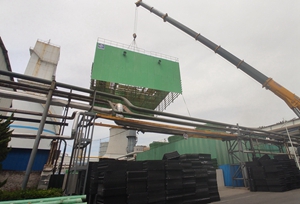
Our FRP cooling tower has a water treatment capacity of 3000m3/h and is currently being installed in a large steel plant. Our products have undergone their inspection.Our products are widely used in industries such as coking, steelmaking, metallurgy, etc
Градирня закрытого типа
Градирня закрытого типа, в отличие от открытой градирни, имеет замкнутое пространство теплообменных труб (радиаторы из гальванизированной или нержавеющей трубы), где и циркулирует охлаждаемая жидкость.
В закрытых мокрых градирнях охлаждаемая вода остается всегда чистой – рабочая жидкость не вступает в контакт с воздухом, а герметичные радиаторы защищают от загрязнений. Подаваемая из чаши насосом вода омывает радиатор конденсатора с воздушным охлаждением и передает тепло потоку воздуха, циркулирующему внутри градирни с помощью радиальных вентиляторов .
1. Мощные вентиляторы позволяют устанавливать в градирне несколько рядов теплообменника, за счет чего теплопередающая поверхность увеличивается, а температура максимально снижается.
2. Специальный конструктив градирен с высокой охлаждающей способностью (противоточная компоновка наиболее эффективна для теплообмена). На всасывании воздуха обеспечивается равномерность распределения воздушных потоков, за счет чего достигается высокий КПД градирни.
3. Эффективная водораспределительная система:
— уникальная форма форсунок, которые устанавливаются в определенном порядке друг напротив друга (факел распыла), обеспечивает равномерный расход воды и эффективное ее распыление по всей теплообменной поверхности.
Price Increase Effective January 1, 2021

In the last few months, key commodities such as carbon steel, galvanized steel, stainless steel, and aluminum have increased significantly. While we have delayed the onset of this higher-priced material, we must implement a price increase moving forward. We will continue to monitor commodity price increases and advise if further HACST price increases are required.
We remain committed to offering the highest quality products and services to our customers. If you have questions or concerns about how this price increase may affect your project, please contact our team of Marketing Engineers for additional assistance.
CCOIC
China Chamber of International Commerce
China Chamber of International Commerce, or CCOIC, was established in 1988 with the approval of the State Council of the People’s Republic of China. Affiliated to China Council for the Promotion of International Trade (CCPIT), CCOIC is a nationwide chamber of commerce comprised of enterprises, groups and other business organizations that are engaged in international commercial activities in China.
CCOIC adopts a membership system and its main responsibilities include: promoting economic and trade exchanges and cooperation between China and foreign countries; reflecting interest appeal of enterprises to international organizations and government departments of China and foreign countries on behalf of Chinese business community; participating in constitution and promotion of international trade rules; facilitating enterprises to participate in international competition and cooperation; safeguarding legitimate rights of its members, and actively advocating social responsibility and public welfare among business circles.
By mid-December 2019, CCOIC has 246,000 member enterprises, including most central SOEs, national financial institutions, a large number of well-known private enterprises and foreign-funded enterprises. CCOIC has become one of the most influential business associations in China.
With the aim of building a hub-like chamber of commerce, CCOIC has institutional cooperation with other business associations from home and abro...
HACST Expands Line of Cooling Tower
Because of the continuous growth of global orders, we have built another plant with an area of 5000 square meters and two production lines with an annual capacity of 800 units, mainly producing closed circuit cooling tower and evaporative condenser.